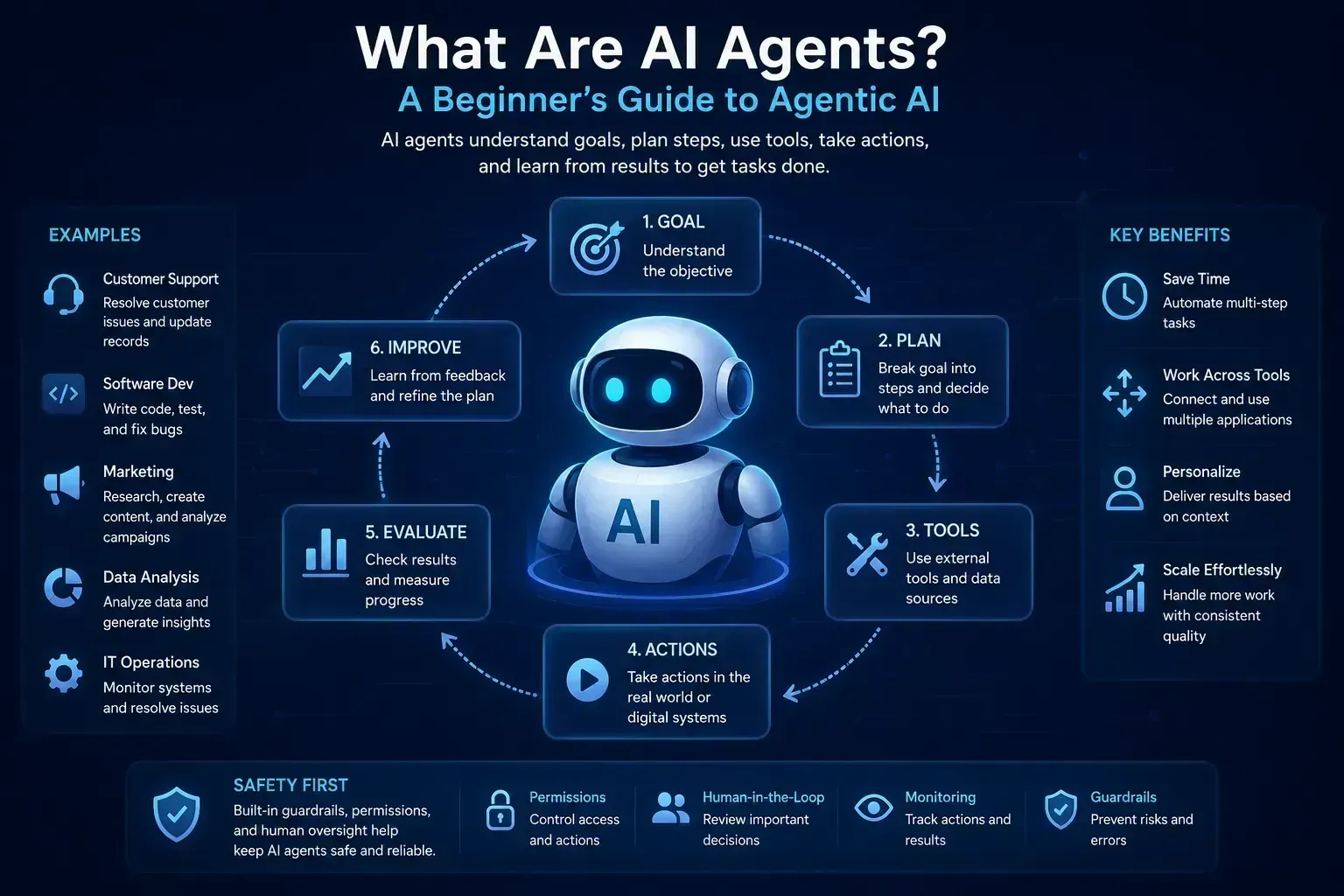
AI agents are artificial intelligence systems designed to understand a goal, make decisions, use available tools, and take actions to complete a task. Unlike basic AI systems that simply answer a question or generate content, an AI agent can often work through several steps toward an objective with less human guidance.
This idea is commonly called agentic AI.
For example, instead of asking an AI system to simply write an email, an AI agent might identify customers who need a follow-up, review relevant information, prepare personalized messages, schedule them, and update a customer relationship management system after completing the task.
That ability to move from answering to acting is what makes AI agents an important development in artificial intelligence.
This beginner’s guide explains how AI agents work, what makes them different from traditional AI, where they are used, their advantages and limitations, and what agentic AI could mean for the future of work and technology.
Table of Contents
What Are AI Agents?
An AI agent is a software system that uses artificial intelligence to pursue a goal, make decisions, and perform tasks on behalf of a user or another system.
Google Cloud describes AI agents as software systems that pursue goals and complete tasks while using capabilities such as reasoning, planning, and memory. You can explore its technical overview in Google Cloud’s guide to AI agents.
In simple terms:
A traditional chatbot mainly responds to you. An AI agent can potentially determine what needs to happen next and take permitted actions toward completing your goal.
Imagine asking:
“Find three suitable hotels for my business trip, compare their locations and prices, and create a shortlist.”
A standard AI assistant might generate recommendations from the information available to it.
A more capable AI agent could potentially:
- Understand your travel requirements.
- Search permitted sources.
- Gather relevant hotel information.
- Compare different options.
- Apply your preferences.
- Rank the results.
- Prepare a shortlist.
- Ask for approval before any sensitive action.
The exact capabilities depend on the model, tools, permissions, data sources, and safeguards connected to the agent.
What Is Agentic AI?
Agentic AI refers to AI systems designed to pursue goals through reasoning, planning, decision-making, and actions rather than simply producing a single response.
The word agentic relates to the ability to act with some degree of independence.
This does not mean an AI system has human consciousness or free will.
Instead, it means software has been designed to work toward an assigned objective within specified instructions and restrictions.
A simplified agentic AI process looks like this:
Goal → Observe → Reason → Plan → Act → Evaluate → Repeat
An agent may repeat this process several times until:
- the task is completed,
- it reaches a predefined limit,
- it encounters a problem,
- additional information is required, or
- human approval is needed.
That feedback loop is one of the major differences between agentic systems and one-time AI responses.
OpenAI’s practical guide to building AI agents covers concepts such as model selection, tools, instructions, orchestration, and guardrails when developing agent-based systems.
How Do AI Agents Work?
Most AI agents combine several technologies rather than relying on one AI model alone.
A typical AI agent might include a language model, instructions, memory, external tools, data sources, and a system for evaluating the results of its actions.
Here is a simplified example.
Suppose a company creates an AI agent with the goal:
“Research five competitors and prepare a market summary.”
The agent might follow these steps.
1. Understand the Goal
First, the agent interprets what the user wants.
It may identify important requirements such as:
- number of competitors,
- industry,
- geographic market,
- information required,
- desired report format.
If important information is missing, a well-designed system may request clarification rather than guessing.
2. Create a Plan
The agent breaks the larger objective into smaller tasks.
For example:
- identify competitors,
- gather information,
- compare products,
- analyze pricing,
- identify strengths and weaknesses,
- summarize findings.
This ability to divide complex work into manageable steps is an important part of agentic AI.
3. Use Tools
The agent may have access to tools beyond the AI model itself.
Depending on its permissions, tools could include:
- web search,
- databases,
- calculators,
- email,
- calendars,
- spreadsheets,
- APIs,
- customer management platforms,
- internal company systems.
The language model helps determine when and how those tools should be used.
4. Evaluate the Results
After completing an action, the agent reviews what happened.
For example, it may determine:
“Only four competitors were identified, but the task requires five.”
The agent can then perform another search instead of immediately stopping.
5. Continue Until the Goal Is Reached
The system continues the reasoning-and-action cycle until the task reaches an acceptable result or a stopping condition is triggered.
This loop gives AI agents more flexibility than traditional rule-based automation.
Core Components of an AI Agent
Although AI agent architectures vary, many systems contain several common components.
AI Model
The AI model acts as an important reasoning and language-processing component.
Modern agents often use large language models because they can interpret natural-language instructions, analyze information, generate plans, and interact with software tools.
Goal
Every agent needs an objective.
For example:
- summarize customer feedback,
- identify qualified sales leads,
- monitor inventory,
- organize meetings,
- troubleshoot technical problems.
Clear goals generally make agent behavior easier to manage.
Instructions
Instructions establish how the agent should behave.
They might define:
- what actions are allowed,
- what actions are prohibited,
- which information to prioritize,
- when human approval is required.
Memory
Some agents can maintain information from previous steps.
Memory might include:
- earlier actions,
- user preferences,
- completed tasks,
- relevant conversation context,
- previous tool results.
Memory allows an agent to maintain continuity during longer workflows.
Tools
Tools allow an agent to interact with systems outside the underlying AI model.
A calculator might help with mathematics, while an API could allow the agent to retrieve information from another application.
Tools turn an AI system from a content generator into something capable of interacting with a broader software environment.
Feedback
Agents may evaluate whether an action successfully moved them closer to their goal.
This feedback can influence the next decision.
AI Agents vs Traditional AI
AI agents and traditional AI applications can use similar underlying models, but their behavior can be very different.
| Feature | Traditional AI | AI Agents |
|---|---|---|
| Main purpose | Generate a response | Pursue a goal |
| Number of steps | Usually one interaction | Often multiple steps |
| Planning | Limited | Can create task plans |
| Tool usage | Sometimes | Often central |
| Memory | Often limited | May maintain task context |
| Actions | Mainly provides information | May interact with external systems |
| Autonomy | Low | Can be higher within defined limits |
For example, a standard generative AI system may create a marketing plan.
An agentic system could potentially create the plan, research competitors, organize tasks, update a project management platform, and later check progress.
If you are new to the broader topic, read our What Is Artificial Intelligence? to understand the foundations of AI before exploring more advanced systems such as agents.
AI Agents vs Generative AI
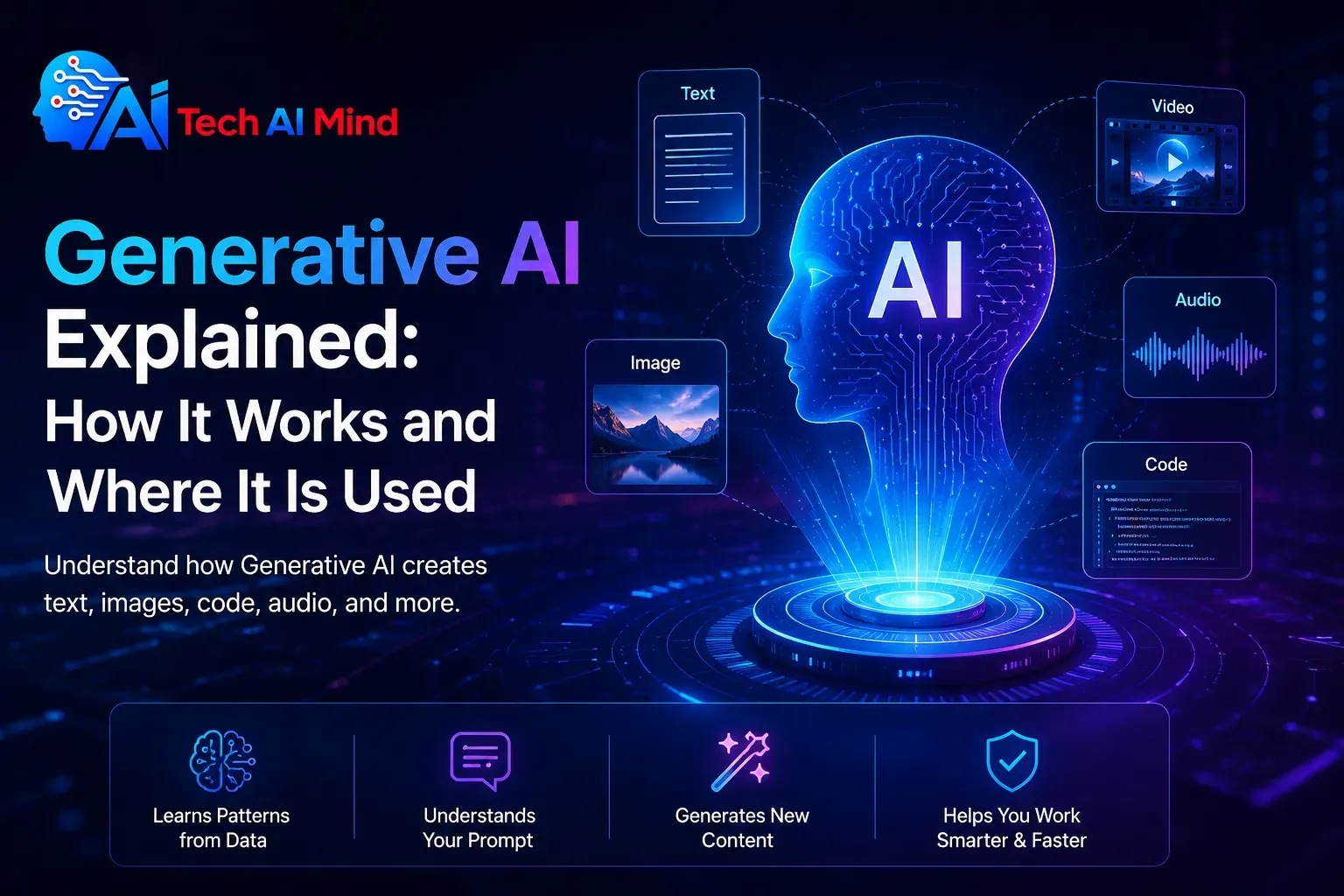
AI agents and generative AI are related, but they are not the same thing.
Generative AI primarily creates new content such as:
- text,
- images,
- audio,
- video,
- software code.
An AI agent focuses on accomplishing goals through a sequence of decisions and actions.
Generative AI can therefore be one component inside an AI agent.
For example, a marketing agent might:
- Research a topic.
- Identify keywords.
- Generate an article outline.
- Draft content using generative AI.
- Review the draft.
- prepare supporting material.
To understand the content-generation side in more detail, see our guide to generative AI explained.
Types of AI Agents
There is no single universal classification of modern AI agents, but several patterns are commonly discussed.
Simple Reactive Agents
These systems respond to current information using predefined rules or logic.
They usually do not perform advanced long-term planning.
A basic automated support system is one example.
Goal-Based Agents
Goal-based agents evaluate possible actions according to whether those actions help achieve a particular objective.
Their behavior is therefore based on a desired result rather than only reacting to individual inputs.
Learning Agents
Learning agents attempt to improve their behavior using data, feedback, or previous experiences.
Machine learning techniques can help these systems adapt to changing environments.
Tool-Using AI Agents
Many modern agentic systems are based on language models connected to software tools.
These agents may use:
- search engines,
- databases,
- code interpreters,
- APIs,
- business software.
Tool use dramatically expands what an AI system can accomplish.
Multi-Agent Systems
Instead of relying on one agent, some systems use multiple specialized agents working together.
For example:
Research Agent → Analysis Agent → Writing Agent → Review Agent
Each agent may focus on a different part of the workflow.
A coordinating system can then manage how information moves between them.
Real-World Examples of AI Agents
AI agents could support many everyday and business activities.
Customer Service
An AI support agent might:
- classify a customer request,
- search documentation,
- retrieve account information,
- suggest a solution,
- escalate complicated cases.
Human oversight remains especially important when decisions involve sensitive accounts, payments, or personal information.
Software Development
Coding agents can potentially help developers:
- analyze software requirements,
- generate code,
- search a codebase,
- run tests,
- identify errors,
- suggest fixes.
Developers still need to review generated software, particularly when security or critical systems are involved.
Marketing
Marketing agents may assist with:
- keyword research,
- audience research,
- content planning,
- campaign analysis,
- reporting.
Rather than completing each task manually, a marketer may assign an objective and supervise the resulting workflow.
Sales
Sales agents can help organize activities such as:
- lead research,
- lead qualification,
- account research,
- follow-up preparation,
- CRM updates.
Important customer communications should still follow company policies and appropriate human review processes.
Data Analysis
An AI agent could receive a dataset and:
- inspect the data,
- identify missing information,
- perform calculations,
- create visualizations,
- highlight trends,
- prepare a summary.
This creates a more interactive form of data analysis.
IT Operations
AI agents may help technical teams monitor systems, analyze alerts, search logs, recommend fixes, or automate approved maintenance tasks.
What Are the Benefits of AI Agents?
Agentic systems are attracting attention because they could reduce the amount of manual coordination required for complex digital work.
Automating Multi-Step Tasks
Traditional automation works particularly well when every step can be predicted in advance.
AI agents can potentially handle situations where the exact steps vary.
Instead of programming:
Step A → Step B → Step C
you may provide:
Goal → Determine appropriate steps → Complete task
This can make automation more flexible.
Saving Time
Agents can automate repetitive tasks such as collecting information, organizing documents, generating reports, and updating systems.
People can then spend more time on decisions requiring judgment, creativity, communication, or expertise.
Working Across Multiple Tools
Many business processes involve moving information between applications.
An agent may help connect those steps.
For example:
Email → CRM → Calendar → Spreadsheet → Report
This could reduce repetitive copying and data entry.
Personalization
Agents can sometimes use relevant user preferences or business information to customize their actions.
A travel assistant, for example, might prioritize hotels based on budget, preferred location, and previous choices.
Scalability
Organizations can potentially use agents to handle large numbers of repetitive workflows while allowing employees to focus on exceptional or high-value cases.
What Are the Risks and Limitations of Agentic AI?
The ability to take actions also creates important risks.
Incorrect Decisions
AI models can produce inaccurate information.
If an inaccurate answer becomes an automated action, the consequences may be more significant.
This is why high-impact agent workflows often require verification and human approval.
Hallucinations
Generative AI systems can sometimes produce convincing information that is incorrect or unsupported.
Agent developers therefore need validation systems rather than assuming every generated output is accurate.
Security Risks
Agents connected to external tools may have access to:
- emails,
- documents,
- databases,
- software systems,
- private information.
Poorly configured permissions could create security problems.
Agents should generally receive only the access required to complete their assigned tasks.
Privacy
Businesses must carefully control how personal and confidential information is processed by AI systems.
Privacy requirements may depend on the type of information, industry, service provider, and country involved.
Unexpected Actions
Even when the goal is clear, an agent may choose an unexpected path toward completing it.
Developers can reduce this risk using:
- permission boundaries,
- approval requirements,
- monitoring,
- testing,
- action limits,
- audit logs.
Cost
An agent may perform multiple AI requests and tool calls during one task.
Complex workflows can therefore require considerably more computing resources than a single chatbot interaction.
Do AI Agents Work Completely on Their Own?
Not necessarily.
Agentic AI exists on a spectrum.
Some agents operate with very limited independence, while others can execute many steps before requesting human input.
A useful model is:
Human controlled → Human supervised → Semi-autonomous → Highly autonomous
The appropriate level depends on the task.
For example, an agent summarizing publicly available documents may require relatively little supervision.
An AI system approving financial transactions should involve much stronger controls.
Autonomy should therefore be matched to the potential consequences of an error.
What Is Human-in-the-Loop AI?
Human-in-the-loop means people remain involved at important stages of an AI workflow.
An agent might research and recommend an action but wait for a person before executing it.
For example:
AI agent: “I prepared the email and identified 250 recipients. Would you like me to send it?”
The human reviews the proposed action before approval.
This approach combines automation with oversight.
It can be particularly valuable for:
- financial decisions,
- legal work,
- healthcare,
- security,
- hiring,
- publishing,
- important customer communications.
How Are AI Agents Different From Automation?
Traditional automation follows explicit instructions.
For example:
When a customer submits this form, copy the information into a spreadsheet.
The workflow is predetermined.
An AI agent may receive a broader goal:
Organize new customer inquiries and identify which ones need immediate attention.
It can analyze the individual situation before deciding what action is appropriate.
Traditional automation remains useful when workflows are predictable.
Agentic AI becomes particularly interesting when tasks involve interpretation, reasoning, or changing conditions.
In many real systems, both approaches can work together.
What Is a Multi-Agent AI System?
A multi-agent system uses multiple AI agents that collaborate or divide responsibilities.
Consider a content workflow:
Agent 1 — Research
Collects relevant information.
Agent 2 — Strategy
Identifies important topics and search intent.
Agent 3 — Writer
Creates the first draft.
Agent 4 — Reviewer
Checks the content for problems.
A coordinating system can manage the agents and combine their outputs.
Multi-agent architectures can be useful for complicated workflows, although they can also increase cost, complexity, and the possibility of errors.
Are AI Agents the Future of Work?
AI agents are likely to influence how many digital tasks are performed, but the broader impact will depend on how reliably and responsibly organizations can deploy them.
A major change could be the movement from:
Using software manually
to:
Giving software an objective and supervising the result.
Instead of spending significant time moving information between applications, workers may increasingly supervise AI systems that perform portions of those processes.
This could change roles in areas including:
- marketing,
- programming,
- customer support,
- administration,
- finance,
- research,
- data analysis,
- operations.
However, AI agents are more likely to change individual tasks differently across occupations than to instantly replace every role.
Human judgment remains important wherever context, responsibility, trust, creativity, ethics, or accountability matters.
Frequently Asked Questions About AI Agents
What is an AI agent in simple terms?
An AI agent is software that can receive a goal, determine what steps may be required, use available information or tools, and perform actions toward completing the goal.
What does agentic AI mean?
Agentic AI describes artificial intelligence systems designed to pursue objectives through planning, reasoning, tool use, and repeated actions.
Are Chatbots AI agents?
Not every chatbot is an AI agent. A basic chatbot primarily responds to messages. A chatbot connected to tools, memory, planning systems, and external actions may function as part of an agentic system.
Can AI agents make decisions?
AI agents can make computational decisions based on their instructions, available information, models, and programmed constraints. That does not mean they possess human understanding, consciousness, or judgment.
Can AI agents use the internet?
Some can, but only when they are provided with internet-access tools and appropriate permissions. Internet access is not automatically available to every AI agent.
Can AI agents make mistakes?
Yes. AI agents can misunderstand instructions, rely on inaccurate information, generate incorrect outputs, or select inappropriate actions. Important workflows should include safeguards and verification.
Do AI agents replace employees?
AI agents can automate parts of some jobs, but their impact varies significantly by occupation and task. Many implementations are designed to assist workers by handling repetitive or time-consuming processes.
Conclusion: Why AI Agents Matter
AI agents represent an important shift in how people interact with artificial intelligence.
Instead of using AI only to answer questions or generate content, agentic systems can potentially receive a goal, develop a plan, use tools, perform actions, evaluate the results, and continue working toward the desired outcome.
The basic process can be summarized as:
Understand → Plan → Act → Evaluate → Improve
This makes agentic AI promising for tasks ranging from customer support and software development to research, marketing, data analysis, and business operations.
However, greater autonomy also introduces greater responsibility. Security controls, data privacy, accuracy checks, permission limits, transparency, and human oversight become increasingly important when an AI system can perform real-world actions.
For beginners exploring artificial intelligence, understanding what AI agents are is becoming increasingly useful because they show how AI is evolving from systems that mainly generate answers into systems capable of helping complete entire workflows.
One thought on “What Are AI Agents? A Beginner’s Guide to Agentic AI”