AI reasoning models are artificial intelligence systems designed to spend more computational effort analyzing difficult problems before producing an answer. Instead of immediately predicting a response, these models can break complicated tasks into smaller parts, evaluate possible approaches, use tools when available, and refine their answers before responding.
Reasoning models have become especially important for mathematics, programming, science, research, planning, and other tasks where the correct answer may require several connected steps.
But what actually happens when an AI model “reasons”?
This beginner-friendly guide explains how AI reasoning models work, how they differ from standard large language models, what makes them useful, where they can fail, and how reasoning technology connects with generative AI and AI agents.
What Are AI Reasoning Models?
An AI reasoning model is an artificial intelligence model optimized for solving problems that require analysis, planning, logic, or multiple computational steps before producing a final answer.
Traditional large language models generate responses by predicting sequences of tokens based on patterns learned during training.
Reasoning models use similar foundations, but they are optimized to dedicate additional computational resources to difficult problems.
Developers interested in a technical explanation can explore OpenAI’s reasoning documentation, which covers reasoning models and how reasoning effort can be managed for different tasks.
A simplified comparison looks like this:
Standard AI model:
Question → Generate response
Reasoning AI model:
Question → Understand → Analyze → Evaluate → Generate response
The extra computational work can be especially useful when an answer depends on several connected pieces of information.
How AI Reasoning Models Work
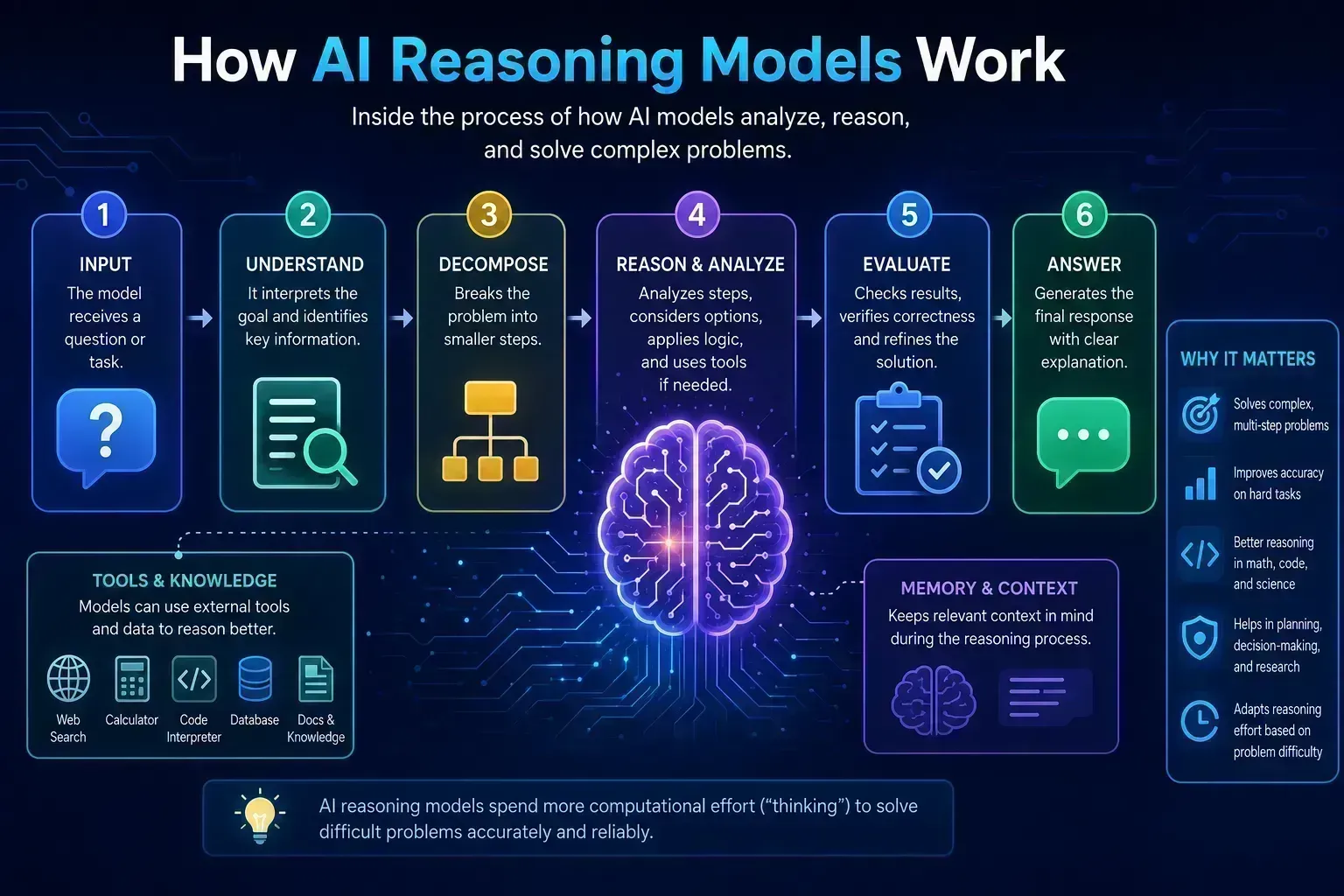
At a high level, AI reasoning models work by allocating additional computation to analyze a problem before producing the final answer.
The exact internal architecture differs between AI systems, and not every provider exposes the same information about its models.
However, a simplified reasoning process can be represented like this:
Input → Understand → Decompose → Reason → Evaluate → Answer
Let’s examine each stage.
1. The Model Receives a Prompt
Everything begins with input.
For example:
A shop sells a laptop for $1,200 and offers a 15% discount. What is the final price?
The model first processes the words, numbers, instructions, and context.
Instead of immediately producing a likely answer, a reasoning-oriented system can devote additional computational effort to the problem.
2. The Model Identifies the Goal
Next, the system determines what the user is asking.
In the laptop example, the objective is not simply to discuss discounts.
The required outcome is:
Calculate the final price after a 15% reduction.
Understanding the goal is particularly important when prompts contain several instructions or pieces of information.
3. The Problem May Be Broken Into Smaller Parts
Complex tasks can often be easier to solve when divided into smaller components.
For example:
Problem: Calculate the discounted laptop price.
The conceptual steps are:
- Determine 15% of $1,200.
- Subtract the discount from the original price.
- Return the final amount.
For a programming problem, a model might instead need to understand the requirements, identify relevant code, determine the likely bug, develop a correction, and verify whether the proposed solution satisfies the original requirements.
This type of multi-stage analysis is one reason reasoning models can perform better on difficult tasks.
What Does It Mean When an AI Model “Thinks”?
Terms such as thinking model and reasoning model can be confusing because computers do not think exactly like humans.
When AI companies describe models as reasoning or thinking systems, they generally mean the model can allocate additional processing to difficult tasks before producing its final response.
Google, for example, has described its Gemini thinking models as capable of using additional reasoning before responding and has provided controls over how much computation is devoted to that process.
Anthropic similarly provides extended and adaptive thinking capabilities for some Claude models, allowing additional computation to be used for more challenging problems.
This does not mean an AI system has:
- consciousness,
- emotions,
- self-awareness,
- human understanding,
- personal beliefs.
“Reasoning” is a technical description of computational problem-solving behavior.
AI Reasoning Models vs Standard Large Language Models
Reasoning models and standard LLMs share many underlying concepts, but they may behave differently.
| Feature | Standard LLM | AI Reasoning Model |
|---|---|---|
| Simple questions | Very effective | Very effective |
| Complex logic | Can struggle | Usually better suited |
| Multi-step problems | More limited | Stronger emphasis |
| Response speed | Often faster | May take longer |
| Computational cost | Usually lower | Can be higher |
| Mathematics | Variable | Often improved |
| Complex coding | Good | Often better suited |
| Planning | Moderate | Stronger focus |
| Tool use | Possible | Often combined with reasoning |
A standard model might be ideal for:
- rewriting text,
- summarizing documents,
- brainstorming,
- creating simple descriptions,
- answering straightforward questions.
A reasoning model becomes more valuable when the problem requires:
- several logical steps,
- complex calculations,
- planning,
- debugging,
- comparing alternatives,
- evaluating constraints.
The distinction is becoming less rigid because modern AI systems increasingly combine fast responses and deeper reasoning within the same model family.
What Is Inference-Time Reasoning?
One of the most important concepts behind modern reasoning AI is inference-time computation.
What Is Inference?
Inference is the stage when a trained AI model receives new input and generates an output.
Training happens beforehand.
Inference happens when you actually use the model.
For example:
Training: The AI learns from large amounts of data.
Inference: You ask the trained model to solve a new problem.
Traditional language models generally try to generate an answer efficiently during inference.
Reasoning models may use more computational resources during this stage to improve their performance on difficult problems.
In simple terms:
A difficult problem may receive more computational attention than an easy one.
This introduces an important trade-off.
More reasoning can improve results, but it can also increase latency and computational cost.
OpenAI, Google, and Anthropic all provide mechanisms in some of their systems for controlling or adapting the amount of reasoning used for a task.
What Is a Reasoning Budget?
A reasoning budget describes how much computational effort a system is allowed to devote to analyzing a problem.
Imagine three settings:
Low reasoning
Useful for easier tasks where speed matters.
Medium reasoning
Useful for moderately complicated problems.
High reasoning
Useful for difficult mathematics, coding, planning, or analysis.
More computational effort does not guarantee a correct answer.
However, giving a capable reasoning model additional resources can help on tasks that benefit from deeper analysis.
Google has publicly discussed thinking budgets for its Gemini models, while OpenAI exposes reasoning-effort controls for supported reasoning models.
How Are AI Reasoning Models Trained?
Reasoning models generally begin with the same broad foundation used by modern large language models.
Pretraining
During pretraining, an AI model learns statistical relationships from large amounts of data.
It develops capabilities involving:
- language,
- concepts,
- patterns,
- facts,
- code,
- mathematics.
If you are new to these concepts, start with our What Is Artificial Intelligence? beginner’s guide.
Post-Training
After basic training, models may undergo additional training designed to improve their usefulness, safety, instruction-following, and problem-solving abilities.
Different AI companies use different techniques.
These can include human feedback, AI-generated feedback, reinforcement learning, curated examples, and specialized evaluation tasks.
The goal is to encourage behavior that produces better solutions rather than simply generating plausible-looking text.
Reinforcement Learning
Reinforcement learning can help train a model by rewarding successful behavior.
Consider a mathematics problem.
If the model produces the correct result using effective problem-solving behavior, the training system can provide a positive signal.
Across large numbers of examples, this can improve the model’s ability to solve new problems.
The important idea is:
Training rewards successful problem-solving behavior, helping the system learn strategies that generalize to new tasks.
Do AI Reasoning Models Use Chain-of-Thought?
The phrase chain-of-thought is often associated with reasoning AI.
It generally refers to intermediate reasoning involved in working through a problem.
However, there is an important distinction between:
a model’s internal computational process
and
an explanation shown to the user.
They should not automatically be treated as the same thing.
Research from AI developers has shown that visible or reported reasoning may not always provide a complete or perfectly faithful representation of the computations responsible for a model’s answer.
For practical purposes, users normally need:
- the answer,
- important assumptions,
- relevant evidence,
- calculations when useful,
- a concise explanation of the method.
A long transcript of internal processing is generally unnecessary for understanding whether an answer is useful.
Why Reasoning Models Are Better at Complex Problems
Consider this simple question:
What is the capital of Japan?
A model does not need complicated reasoning.
The answer is Tokyo.
Now consider:
A company has three warehouses, different transportation costs, limited inventory, and five customer regions. What distribution strategy minimizes shipping costs while meeting demand?
That problem requires much more.
The model may need to:
- identify variables,
- understand constraints,
- compare alternatives,
- perform calculations,
- detect conflicts,
- evaluate possible solutions.
Reasoning models are designed for situations like this.
The greater the number of connected constraints, the more valuable deliberate computational analysis can become.
What Tasks Are AI Reasoning Models Good At?
Reasoning models can be especially useful for tasks involving multiple dependencies or logical steps.
Mathematics
They can help with:
- algebra,
- geometry,
- probability,
- statistics,
- word problems,
- mathematical proofs.
They can still make mistakes, so important calculations should be verified.
Programming
Reasoning AI can help developers:
- understand codebases,
- identify bugs,
- plan software architecture,
- generate functions,
- analyze errors,
- debug code,
- create tests.
Programming often benefits from reasoning because changing one part of a system can affect other parts.
Scientific Problems
Reasoning systems can assist with:
- interpreting research questions,
- analyzing experimental information,
- exploring hypotheses,
- performing calculations,
- comparing possible explanations.
AI-generated scientific conclusions still require expert verification.
Planning
Planning often requires understanding several constraints simultaneously.
Examples include:
- project planning,
- resource allocation,
- workflow design,
- scheduling,
- logistics.
Data Analysis
A reasoning model can potentially:
- understand the question,
- inspect available data,
- determine an appropriate method,
- perform analysis,
- evaluate results,
- explain the findings.
Research
Reasoning models can help organize complex research by separating a broad question into smaller information needs.
When connected to appropriate tools, they may also search, retrieve, analyze, and compare information.
AI Reasoning Models and Tool Use
Reasoning becomes considerably more powerful when AI can use external tools.
Imagine asking:
Which of these three loans has the lowest total cost over five years?
A reasoning model may need to:
- extract interest rates,
- identify fees,
- use a calculator,
- compare payment schedules,
- check totals,
- explain the result.
Possible AI tools include:
- calculators,
- web search,
- code interpreters,
- databases,
- APIs,
- document retrieval systems.
This creates a cycle such as:
Reason → Select Tool → Receive Result → Evaluate → Continue
Tool use also connects reasoning models to another major AI concept: AI agents.
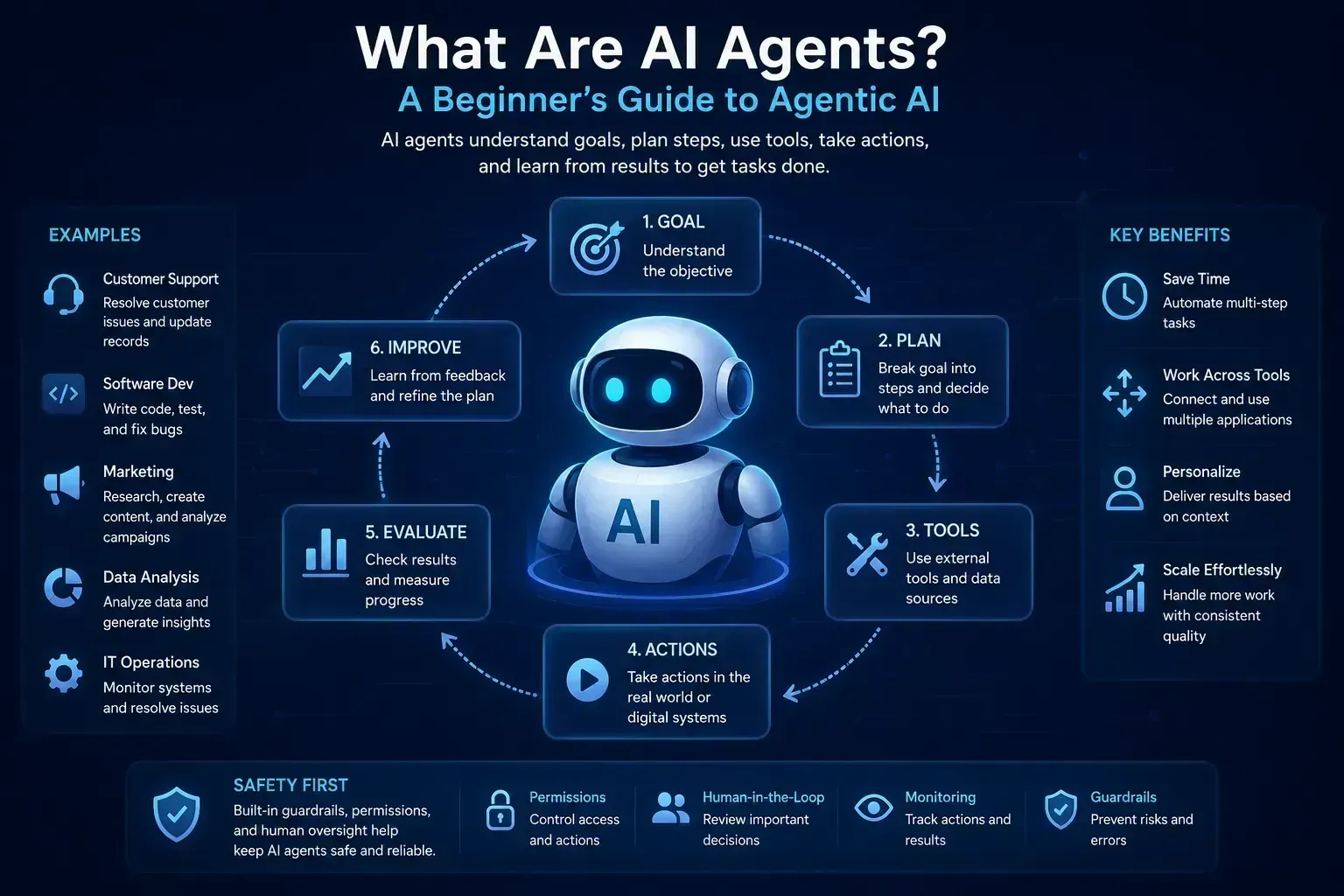
Read our beginner’s guide to AI agents to understand how models can combine reasoning with tools and actions to complete larger objectives.
AI Reasoning Models vs AI Agents
These terms are related but should not be treated as synonyms.
AI Reasoning Model
A reasoning model is primarily the intelligence or problem-solving component.
It helps analyze questions and determine possible solutions.
AI Agent
An AI agent is a broader system designed to pursue a goal.
An agent may combine:
- a reasoning model,
- memory,
- instructions,
- tools,
- external data,
- permissions,
- actions.
A simple way to understand the relationship is:
Reasoning model = problem-solving engine
AI agent = system that uses intelligence to pursue a goal
A reasoning model can therefore serve as the decision-making component inside an agentic workflow.
AI Reasoning Models vs Generative AI
Reasoning AI is also closely related to generative AI.
Generative AI creates new content such as:
- text,
- images,
- audio,
- video,
- computer code.
Reasoning AI emphasizes analyzing complex problems.
The two capabilities can exist in the same system.
For example, an AI model could:
- reason about a software problem,
- develop a solution,
- generate the required code.
The reasoning stage determines what should be done.
The generative stage creates the output.
For a broader explanation, see our Generative AI Explained guide.
Can Reasoning Models Check Their Own Answers?
Reasoning systems can sometimes perform additional evaluation before returning an answer.
A simplified workflow could be:
Generate candidate → Evaluate candidate → Identify problem → Revise → Respond
This is useful because the first possible solution is not always the best one.
For example, when solving code, a model may evaluate whether:
- the syntax is valid,
- requirements were satisfied,
- an edge case was missed,
- the proposed solution introduces another problem.
However, self-evaluation is not perfect.
An AI model can confidently approve an incorrect result.
Independent verification remains important.
Can AI Reasoning Models Still Hallucinate?
Yes.
Reasoning capability does not eliminate hallucinations.
An AI reasoning model may still:
- invent facts,
- misunderstand a question,
- use incorrect assumptions,
- perform calculations incorrectly,
- misinterpret evidence,
- cite unsupported information,
- reach the wrong conclusion.
A longer reasoning process is not automatically a correct reasoning process.
For high-stakes areas such as medicine, law, financial decisions, engineering, and cybersecurity, expert verification remains essential.
Why Do Reasoning Models Sometimes Respond More Slowly?
Reasoning models can require additional computation before producing an answer.
That creates a trade-off between:
Speed ↔ Depth
For a simple question, extensive reasoning may offer little benefit.
For a complicated programming problem, additional analysis may substantially improve the result.
This is why some modern systems dynamically adjust how much reasoning they use or allow developers to control reasoning effort.
The goal is not necessarily:
reason as much as possible.
A better objective is:
use the appropriate amount of reasoning for the problem.
Benefits of AI Reasoning Models
Better Complex Problem Solving
Reasoning models can handle problems involving multiple connected steps more effectively than systems optimized mainly for immediate responses.
Improved Planning
They can evaluate constraints before suggesting an approach.
Stronger Coding Assistance
Programming naturally involves dependencies, logic, testing, and debugging, making it well suited to reasoning-oriented systems.
More Useful Tool Use
A model that can reason about which tool it needs may perform more complicated workflows.
Better Analysis
Reasoning can help the model compare evidence rather than immediately generating an answer from the first available pattern.
Limitations of AI Reasoning Models
Despite their advantages, reasoning AI has important limitations.
Higher Computational Cost
Additional reasoning generally requires more processing.
Longer Response Times
Complex reasoning can increase latency.
Reasoning Does Not Guarantee Accuracy
A model can analyze a problem extensively and still reach the wrong conclusion.
Poor Inputs Can Produce Poor Results
If the model receives inaccurate or incomplete information, additional reasoning may not fix the underlying data problem.
Difficult Problems Remain Difficult
AI reasoning models are not perfect general-purpose problem solvers.
Some tasks remain beyond their capabilities.
Verification Is Still Necessary
Important outputs should be checked against reliable evidence, calculations, tests, or expert knowledge.
Are AI Reasoning Models Conscious?
No evidence that a model produces complex reasoning-like behavior should be treated as proof that the model possesses human-like consciousness.
AI systems process information computationally.
Their ability to:
- analyze,
- plan,
- calculate,
- generate language,
- evaluate options
does not by itself demonstrate subjective awareness.
It is useful to separate:
intelligent behavior
from
human consciousness.
AI systems can demonstrate increasingly sophisticated problem-solving behavior without being assumed to experience thought in the human sense.
What Is the Future of AI Reasoning?
A major direction in AI development is combining reasoning with other capabilities.
Future and emerging systems increasingly integrate:
Reasoning + Tools + Memory + Multimodal Input + Agents
A model might analyze a request, inspect documents, use software tools, interpret images, execute code, and coordinate several steps toward a larger objective.
Modern AI developers are already combining deeper reasoning with multimodal capabilities, tool use, coding, and agentic workflows.
This means the importance of reasoning models extends beyond answering difficult questions.
Reasoning can become the decision-making layer that helps AI systems determine:
What should I do next?
That capability is fundamental to more advanced AI assistants and autonomous agent systems.
Frequently Asked Questions About AI Reasoning Models
What is an AI reasoning model?
An AI reasoning model is an artificial intelligence model optimized to analyze complex problems using additional computational processing before producing its final answer.
How do AI reasoning models work?
AI reasoning models process a request, identify the objective, analyze relevant information, evaluate possible approaches, and generate a response.
Are reasoning models different from regular AI?
Yes, although they often share similar technical foundations. Reasoning models place greater emphasis on complex problem solving, planning, mathematics, coding, and analysis.
Are AI reasoning models always more accurate?
No. Additional reasoning may improve performance on appropriate tasks, but AI can still misunderstand information or produce incorrect answers.
Why can reasoning models be slower?
They may use additional inference-time computation before generating their final response.
What is inference-time reasoning?
Inference-time reasoning refers to using computational resources for analysis while a trained AI model is processing and answering a new request.
What is a reasoning budget?
A reasoning budget describes or controls how much computational effort a system dedicates to working through a problem.
Conclusion: How AI Reasoning Models Work
Understanding how AI reasoning models work helps explain one of the most important developments in modern artificial intelligence.
Instead of immediately generating an answer, reasoning-oriented AI can devote additional computational effort to difficult tasks.
A simplified process is:
Understand → Break Down → Analyze → Evaluate → Respond
This makes AI reasoning models particularly useful for complex mathematics, coding, research, planning, data analysis, and other tasks where several pieces of information must be considered together.
However, deeper reasoning should not be confused with guaranteed accuracy. These systems can still hallucinate, misunderstand information, make incorrect assumptions, and produce wrong conclusions.
The most important development may be what happens when reasoning is combined with other AI technologies:
Reasoning + Generative AI + Tools + Memory + AI Agents
Together, these capabilities are moving artificial intelligence beyond simple question answering toward systems capable of analyzing complicated situations and helping people complete multi-step digital work.